My Mind Is Like Funny Skeleton PNG SVG
First Impressions: A Witty, Wearable Vibe
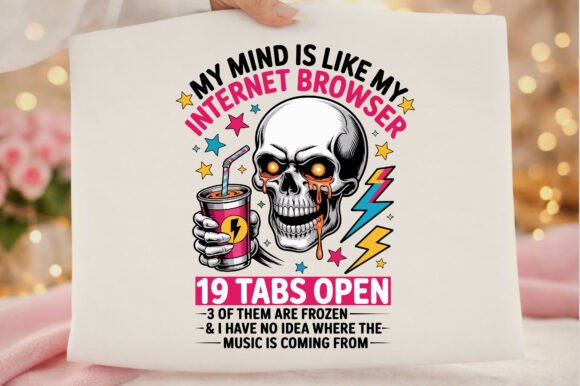
Opening My Mind Is Like Funny Skeleton PNG SVG, I immediately felt its personality—dry, caffeinated, and unapologetically human. It’s not just a skeleton; it’s a coffee-stained, slightly exasperated, wryly grinning figure holding a mug like a lifeline. The composition balances bold silhouette with subtle humor: clean lines, intentional negative space, and expressive posture that reads clearly even at smaller scales. As an embroidery designer, I appreciate how the visual weight leans into readability—not overly fussy, but full of character. This isn’t background filler; it’s a conversation starter. Perfect for a boutique tote bag, a barista’s apron, or a “surviving parenthood” sweatshirt.
Real-World Stitch Test: Tote Bag Edition
Last week, I prepped this design for a custom embroidered canvas tote—60/40 cotton-poly blend, medium weight, medium drape. I resized it to 4.5” wide (keeping proportions intact), digitized a simplified version with balanced satin stitch outlines and open fill areas, and used medium-cutaway stabilizer. The result? Crisp, confident stitching—no thread nesting, no distortion. The skeleton’s grin held up; the mug handle stayed legible. Customers noticed it instantly. One asked, “Is that *me*?” That’s the magic: My Mind Is Like Funny Skeleton PNG SVG lands as relatable, not gimmicky. It works because it’s designed for recognition—not just decoration.
Where It Shines in Embroidery Projects
- Custom apparel: Sweatshirts, crewnecks, and relaxed tees—especially over pockets or left-chest placements—give it breathing room and warmth.
- Tote bag design: The bold shape fills space without overwhelming, and the humor reads well at arm’s length.
- Aprons & kitchen towels: Fits right into café, bakery, or home-kitchen branding—casual but intentional.
- Embroidered patch: Clean edges and moderate detail make it ideal for sew-on or iron-on patches (just add backing).
- Holiday embroidery & personalized gifts: Great for “ugly sweater” swaps, teacher appreciation, or “new parent survival kit” bundles.
- Etsy seller & small shop product: Stands out in thumbnails, scales well for mockups, and pairs effortlessly with minimalist branding.
Use With Care: Practical Embroidery Boundaries
This design is strong—but not bulletproof. Here’s where I pause before stitching:
- Small hoop sizes (under 3”): The fine details—the mug steam, tiny eye highlights, or text curves—risk blurring or disappearing. Resize thoughtfully, or simplify manually.
- Textured or napped fabrics: Fleece, terry cloth, or heavy twill can swallow fine lines. Add extra stabilizer and consider reducing fill density.
- Thin or stretchy fabric: Knits and rayon blends need cutaway + topping. Without it, the skeleton’s outline may pucker or distort.
- Dark fabric: Light thread colors (cream, light gray) lose contrast. Stick to charcoal, navy, or black thread—or invert the color scheme entirely.
- Curved surfaces (caps, beanies): The horizontal layout doesn’t wrap naturally. Reposition vertically or choose a cropped version for front-panel use.
- Frequent-wash items (baby embroidery, tea towels): Avoid dense satin stitch on high-friction zones. Opt for running stitch outlines + open fill for durability.
Design Integrity Meets Customer Trust
When your customer sees My Mind Is Like Funny Skeleton PNG SVG stitched cleanly on their handmade product, they’re not just buying a joke—they’re buying *recognition*. That matters for Etsy sellers and craft fair vendors: clear, confident stitching signals care, skill, and professionalism. I’ve seen this design elevate a basic pillow cover from “cute” to “I need three.” It adds perceived value without demanding premium pricing—because the wit does the work. But only if executed well. Sloppy stitching or poor fabric pairing undermines the charm instantly. So yes—it’s fun, but treat it with the same respect you’d give a monogram or logo.
What Every Embroidery Designer Should Do Before Stitching
Before committing thread or time:
- Test on scrap fabric first—same type, same stabilizer, same thread count.
- Check thread color contrast against both light and dark backgrounds using printable mockups.
- Review stitch density—dense fills on lightweight fabric = stiffness and cracking over time.
- Confirm hoop size compatibility—the original PNG dimensions suggest scalability, but vector files (EPS/AI) must be verified for clean anchor points and grouped layers.
- Inspect small details under magnification—especially the mug rim, teeth, and coffee swirls.
- Test black-and-white mockups to assess tonal balance and silhouette strength.
- Use proper stabilizer—cutaway for knits, tear-away for stable wovens, topping for napped surfaces.
- Verify licensing before selling finished products or bundling as part of a digital embroidery file pack.
Final Thought: Not Just a Graphic—A Mood You Can Stitch
My Mind Is Like Funny Skeleton PNG SVG succeeds because it bridges graphic design and embroidery reality. It’s built for clarity, scaled for impact, and written in a visual language people understand before they even read the words. As a T-Shirt Designs asset, it’s versatile—but its real power unfolds in handmade product contexts: the laugh it sparks at a farmers’ market, the nod it earns in a coffee shop line, the way it softens the stress of a chaotic day. For craft business owners and creative entrepreneurs, it’s more than a Graphics download. It’s a ready-made moment of connection—waiting for the right needle, the right fabric, and the right person to bring it to life.