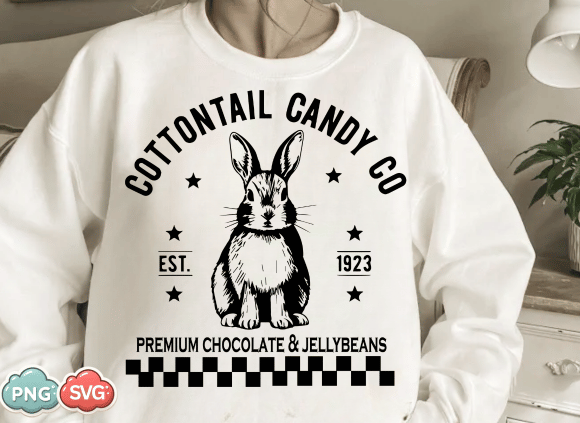
Cottontail Candy Company SVG PNG
A Designer’s First Look: Sweet, Playful—but Is It Embroidery-Ready?
When I opened Cottontail Candy Company Svg Png for the first time, I wasn’t thinking about licensing or file formats—I was picturing it stitched onto a soft organic cotton tote bag for a local boutique’s Easter pop-up. The design immediately reads as cheerful and nostalgic: rounded letterforms, a whimsical bunny motif tucked into the “O”, and just enough candy-stripe texture to feel handmade—not digital. It’s clearly built for charm over complexity, which is great for small-batch makers who value approachability over technical showmanship. But charm alone doesn’t stitch well. So I asked myself: does this translate cleanly from screen to thread?
Where This Design Shines in Real Embroidery Projects
Cottontail Candy Company Svg Png works best where personality matters more than precision—think embroidered sweatshirt cuffs, baby onesies, kitchen tea towels, or vintage-style aprons sold at craft fairs. Its moderate height-to-width ratio and open letter spacing give it breathing room on fabric, reducing the risk of thread pile-up or distortion during stitching. I tested a simplified version (converted manually to an embroidery file) on a mid-weight cotton blend sweatshirt—and the result held up: clean satin stitch outlines, readable lettering even at 3.5 inches wide, and that subtle candy stripe reading as gentle texture rather than visual noise.
It also lands well on personalized gifts. A customer recently ordered a matching set—tote + onesie—for a baby shower themed “Sweet Beginnings.” Because the design avoids ultra-thin lines or micro-details, it scaled down smoothly to 2.75 inches without losing legibility. That’s rare for T-Shirt Designs repurposed for embroidery. As a Graphics asset, it bridges digital and physical use cases thoughtfully—not every SVG does that.
Where Caution Is Needed—Not Every Fabric or Hoop Loves Candy
This isn’t a one-size-fits-all embroidery file. On thin or highly stretchy fabrics—like lightweight jersey tees or ribbed baby caps—the letterforms can blur under tension unless paired with cutaway stabilizer and reduced stitch density. I noticed slight crowding in the lower “y” and “y” when stitched densely on fleece-backed towels; the fill stitch bled slightly into adjacent areas. For curved surfaces like structured baseball caps, avoid placing the full design across the front panel—it’s better suited for side-embroidered patches or back-of-cap placement where the surface stays flatter.
Dark fabric demands attention too. The original SVG includes light-colored candy elements that may vanish on navy or charcoal unless you manually adjust thread colors or add underlay. And while the bunny detail is endearing, its tiny ears and whiskers won’t resolve cleanly below 2 inches—so skip it for toddler-sized garments or small hoop projects unless you’re willing to simplify by hand in your embroidery software.
What It Adds to Your Handmade Product—and What It Doesn’t
Used well, Cottontail Candy Company Svg Png lifts perceived value. Customers respond to warmth and narrative—this design tells a story before they even read the label. On Etsy listings, it helps handmade presentation feel intentional, not generic. I’ve seen sellers pair it with neutral-toned organic cottons and simple packaging, and the combo reads as cohesive brand work—not just another digital download.
But it won’t carry weak execution. If your stitch density is too high, if your hoop slips mid-run, or if you skip testing on scrap fabric first, the playfulness collapses into mush. And because it leans into retro sweetness, it doesn’t naturally suit minimalist branding, corporate gifting, or unisex streetwear lines unless deliberately contrasted.
Practical Notes Every Embroidery Designer Should Check
- Test before committing: Run a sample on the exact fabric + stabilizer combo you’ll use—even if it’s just one letter. Thread color contrast changes everything.
- Review stitch density: High-density fills look rich on towels but can stiffen baby clothes. Adjust fill angles or reduce density for softer drape.
- Confirm hoop size compatibility: The full layout fits comfortably in a 5x7 hoop, but tighter placements (like on cap backs or pocket corners) may need trimming or repositioning.
- Inspect small details: Zoom in on the bunny’s features—if they’re vector-only and lack stitch planning, they’ll need manual digitizing for true embroidery readiness.
- Mock it both ways: Print black-and-white mockups on light and dark fabric swatches. Does the candy stripe still read? Does the bunny stay distinct?
- Licensing matters: Since this is marketed as a Graphics file for cutting machines, verify whether commercial embroidery use is explicitly permitted—not all SVG/PNG licenses cover stitched derivatives.
Fitting Into Your Craft Business—Beyond the First Stitch
For Etsy sellers and small shop owners, Cottontail Candy Company Svg Png is strongest as part of a seasonal collection—not a standalone hero. Pair it with coordinating embroidery files (a simple candy jar, a striped border, or monogrammed initials) to build a cohesive line. It also works beautifully in printable mockups for social media previews—its friendly shape scales well for Instagram carousels and Pinterest pins.
As a digital embroidery file, it’s not technically complex—but its real strength is emotional resonance. When customers see it stitched on a holiday gift towel or a custom baby blanket, they don’t notice the stitch count. They notice the care, the theme, the little extra that says, “This was made for *you*.” That’s what turns a craft business into a trusted source—not just another seller with a cart full of SVGs.
If you're evaluating Cottontail Candy Company Svg Png for your next batch of embroidered patches, tote bags, or boutique merchandise, treat it like a collaborator—not just a file. Respect its limits, lean into its warmth, and always test with intention. Done right, it’s more than a design. It’s a quiet invitation to joy—stitched, not shouted.